
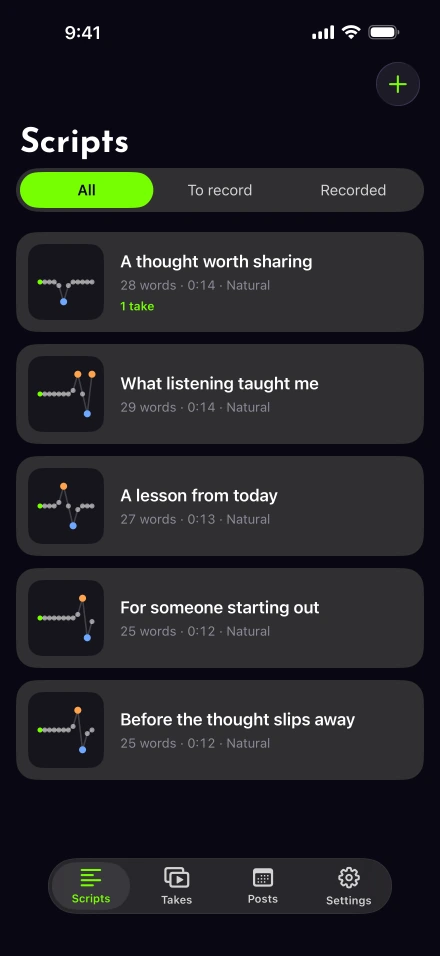
A useful camera script should sound like something you would say to one person. Start with the explanation, example or invitation you want that person to remember, then remove wording that only works on the page. The 60-second script guide gives you a structure; this page covers the tools that hold the finished words.
Can you import a PDF or Word document as a script?
Yes, as long as the PDF has selectable text. Open Scripts › + and choose New script, Paste as new script or Import from Files…. Supported files are .txt, .md, .markdown, .rtf, .pdf and .docx, with a 50,000-character limit. Markdown formatting is removed while individual line breaks remain as prompter line endings.
A PDF needs selectable text: a scan that is only a picture of a page cannot supply words. Password-protected PDFs are refused, as are Word files larger than 30 MB or 60 MB when expanded. If an import fails, copy the readable passage into a new script and inspect it before filming.
Which script templates does Lightshot include?
Five, each written for a common talking video, and each turns bracketed spaces into questions: Coach intro, Welcome a new client, Weekly post, Launch video and Product demo. Answer what you can, then choose Use the outline. Anything skipped stays in brackets, and the editor counts the blanks still to fill.
The coach introduction walkthrough focuses on who you help and what a first conversation involves. For an announcement, the founder launch guide starts from the specific product change. Neither requires inventing a customer story to fill an empty space.
Draft it for me can smooth fully answered lines using Apple Intelligence. The draft is shown for review, so change anything you would not say. Apple’s current Intelligence requirements determine availability; the app uses the Foundation Models framework for this optional assistance. You can still write and use outlines on other supported iPhones.
How long will the script take to say?
Start with the estimate on screen, then time yourself reading it aloud. The editor shows a word count and running time at the script’s pace. Template durations assume about 150 words a minute; they are planning estimates. Put your own text into the script timer when comparing a short opening with a longer explanation.
Silent reading is a poor rehearsal for spoken delivery. A meta-analysis of reading rates treats silent and oral reading separately, while Baruch’s clear-speech advice uses a slower spoken target. Use the pace guide to find a starting point, then time your own read with its real pauses. If the video will teach something unfamiliar, DCMP’s educational caption-rate guidance is another reason to leave the viewer time to read.
What are lift, land and breathe marks?
They are tone cues on the words: on the prompter a lifted word rides higher, a landed word sits lower and a small cup marks a breath. Delivery marks suggest Lift, Land and Breathe. They are added by rules without Apple Intelligence. Tap a word to change its tone; hold it to change a pause. For direct markup, use ^word to lift, _word to land, *word* for emphasis, / for a short pause or // for a longer one.
Natural, Energetic, Calm and Authority provide different starting styles and paces. Try one sentence aloud with your chosen cues. A mark is a prompt for your delivery, not a requirement to sound a certain way. The voice-following mode still takes its movement from your speech; the pace value becomes its starting rate and coaching target.
Give each message a home
Move scripts into folders and use All folders to filter the library. This helps separate an ongoing series from a launch or a new-client welcome video. A short descriptive name is more useful here than another copy called “Final.”
When the bracket count reaches zero and the read feels right, choose Record, Prompter or Demo. The rest of the feature set follows that choice: ordinary camera takes start from Record; screen-recording narration starts from Demo. Keep the script as the preparation, then let the actual spoken take decide the final captions.